
02 April 2026 · Geopolitics · India · Policy · International Relations
India's Strategic Balancing in a Fragmented World Order
By Dr. Harvansh Chawla
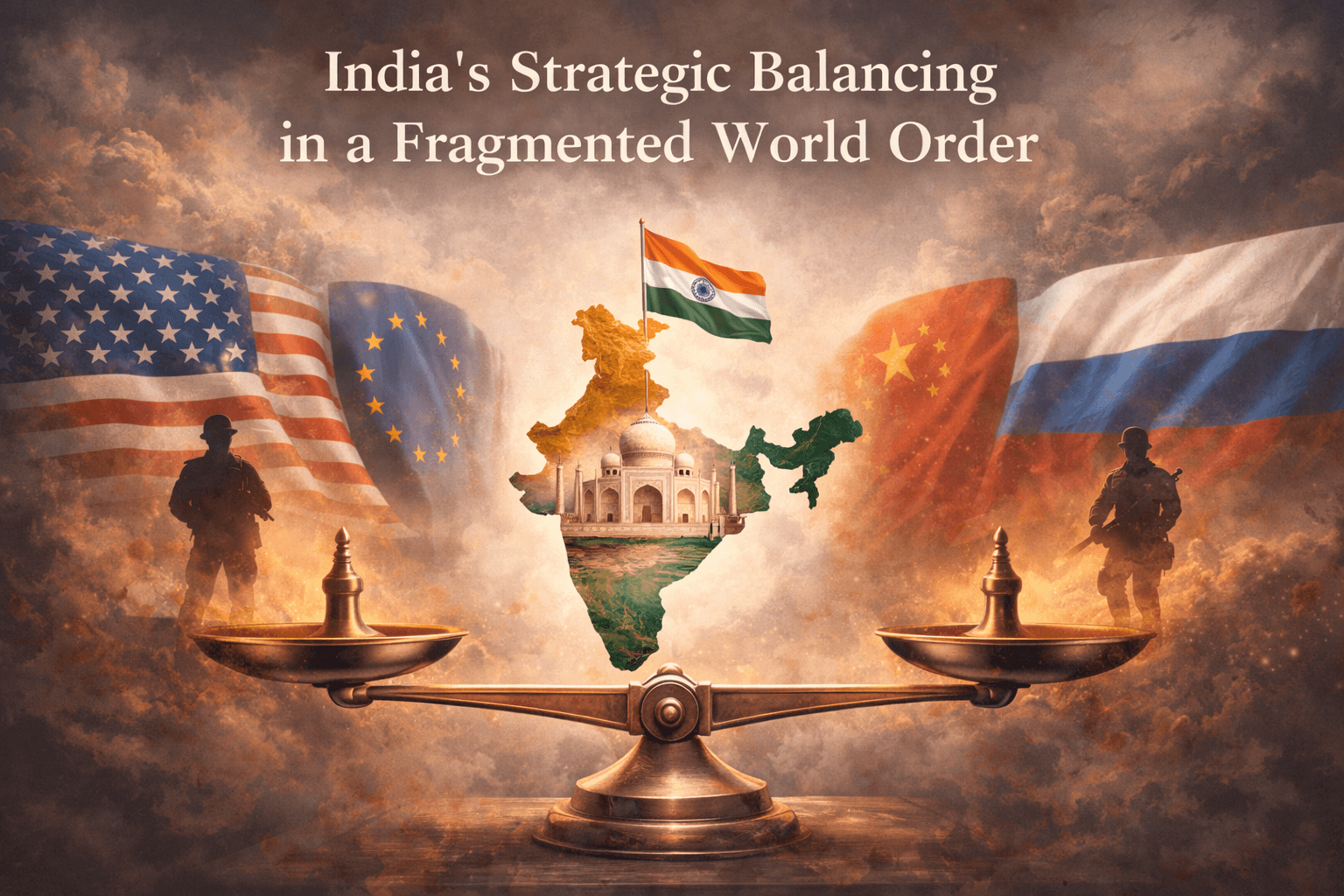
In a fragmented world, clarity does not come from choosing sides—it comes from maintaining balance.
The global order, once defined by relatively stable alignments and predictable power structures, is undergoing a profound transformation. What we are witnessing today is not merely a shift in geopolitics, but the emergence of a more fragmented, fluid, and contested world.
Traditional alliances are being recalibrated. Economic interdependence is increasingly intertwined with strategic caution. Conflicts are no longer confined to borders—they extend into technology, trade, energy, and influence.
In this evolving landscape, India finds itself uniquely positioned—not as a passive observer, but as a balancing force navigating complexity with strategic clarity.
From Alignment to Multi-Alignment
For decades, global politics was shaped by clearly defined blocs. Nations were often compelled to align themselves within rigid frameworks, limiting strategic autonomy.
India's approach has steadily evolved into what may be described as calibrated multi-alignment. Rather than choosing sides, India has chosen engagement.
It maintains strong relations with the United States, deepens strategic partnerships with Europe, engages constructively with Russia, and continues to build ties across West Asia, Africa, and Southeast Asia. Simultaneously, it plays an active role in platforms such as BRICS and the G20, contributing to conversations that shape global governance.
This approach is not indecision—it is strategy.
Strategic Autonomy as Strength
At the heart of India's foreign policy lies the principle of strategic autonomy—a legacy rooted in its historical engagement with the Non-Aligned Movement, but redefined for a far more complex world.
In today's context, strategic autonomy does not imply distance—it implies flexibility. It allows India to:
- Engage with multiple partners without being constrained by bloc politics
- Safeguard national interests across domains
- Respond to crises with independence and credibility
Economic Resilience as Diplomatic Leverage
Economic strength has become a critical component of geopolitical influence. India's sustained growth trajectory, expanding digital infrastructure, and increasing role in global supply chains have significantly strengthened its strategic position.
Trade agreements, energy partnerships, and investment flows are no longer just economic instruments—they are tools of diplomacy.
The Human Dimension: Diaspora and Connectivity
India's global engagement is not limited to statecraft alone. Its vast diaspora represents a powerful bridge between nations. Connectivity initiatives—whether through infrastructure, trade corridors, or digital platforms—are reshaping how India engages with the world.
Navigating Conflict Without Escalation
One of the defining features of India's approach has been its emphasis on dialogue over escalation. In a world marked by increasing conflict, India has consistently advocated restraint, diplomacy, and peaceful resolution.
The Rise of a Multipolar World
The ongoing shifts in global power structures suggest that the era of a singular dominant power is gradually giving way to a multipolar world. India's approach aligns naturally with this emerging reality.
Conclusion: Balance as Influence
In a fragmented world, clarity does not come from choosing sides—it comes from maintaining balance.
India's strategic approach reflects a quiet confidence: the understanding that influence is not always exercised through assertion, but often through engagement.