
20 March 2026 · Law · Technology · AI · Justice
Digital Evidence and Due Process: Are Our Legal Systems Ready for the AI Age?
By Dr. Harvansh Chawla
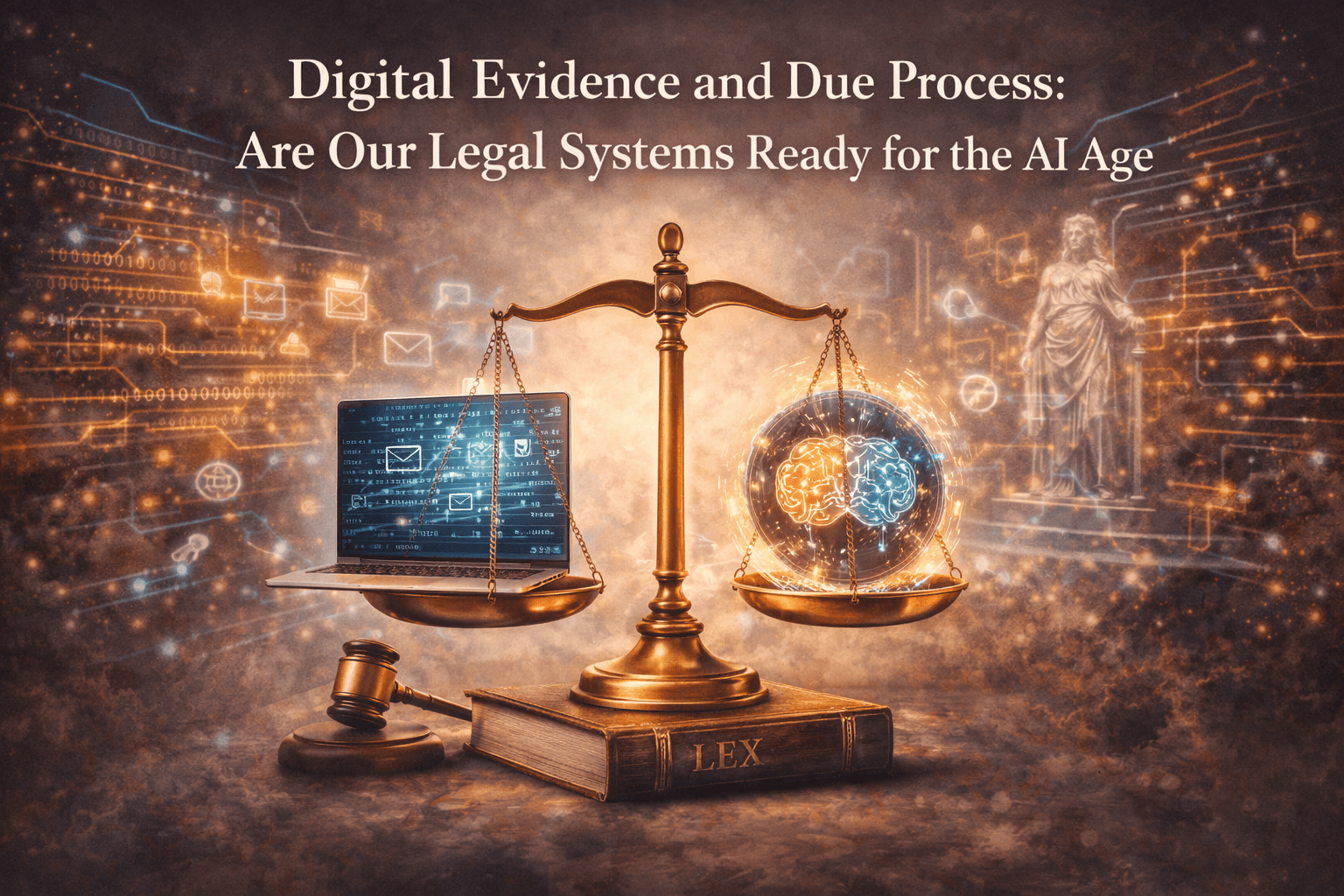
From deepfakes to algorithm-generated content, the nature of digital evidence is evolving at a pace that challenges the very foundations of due process.
The rapid integration of artificial intelligence into everyday life is transforming not just how we communicate, transact, and interact—but also how evidence is created, interpreted, and contested within legal systems.
From deepfakes to algorithm-generated content, the nature of digital evidence is evolving at a pace that challenges the very foundations of due process. Courts today are increasingly confronted with questions that were almost inconceivable a decade ago: How do we establish authenticity in a world where reality itself can be convincingly fabricated? What constitutes reliable evidence when machines—not humans—generate or manipulate information?
These are not merely technical concerns. They strike at the core of justice.
The Changing Nature of Evidence
Traditionally, legal systems have relied on a combination of documentary, oral, and material evidence. Each category came with established methods of verification and standards of admissibility. However, digital evidence—particularly in the age of AI—does not always conform to these established frameworks.
A video, once considered strong visual proof, can now be synthetically altered. Audio recordings can be generated without a speaker ever uttering a word. Documents can be created or modified with minimal trace. The line between authentic and artificial is becoming increasingly blurred.
This shift demands not just new tools, but a rethinking of how evidence itself is understood.
Challenges to Due Process
Due process rests on fairness, transparency, and the ability to test evidence. AI-generated or manipulated content complicates each of these pillars.
- Authenticity becomes uncertain
- Attribution becomes difficult
- Verification requires technical expertise beyond traditional legal training
This creates an imbalance. Those with access to advanced technology may gain an unintended advantage, while courts struggle to keep pace with rapidly evolving digital capabilities.
The risk is not just wrongful conviction or acquittal—it is the erosion of trust in the legal system itself.
The Need for Institutional Preparedness
Legal systems cannot afford to remain reactive. The challenge is not only to adapt, but to anticipate.
This requires:
- Investment in digital forensics infrastructure
- Training for judges, lawyers, and investigators
- Development of clear evidentiary standards for AI-generated content
- Collaboration between legal, technological, and policy communities
Balancing Innovation with Responsibility
Artificial intelligence is not inherently a threat. In fact, it holds immense potential to enhance legal processes—through faster data analysis, predictive insights, and improved access to justice. However, like all powerful tools, it must be approached with responsibility.
A Moment of Reflection
We are at a critical juncture where law and technology are intersecting in unprecedented ways. The choices made today will shape the integrity of legal systems for decades to come.
Because in the age of artificial intelligence, safeguarding truth is no longer just a legal responsibility—it is a societal one.