
14 April 2026
Between Washington, Tehran and Tel Aviv: India’s Quiet Rise as a Stabilising Power
By Dr. Harvansh Chawla
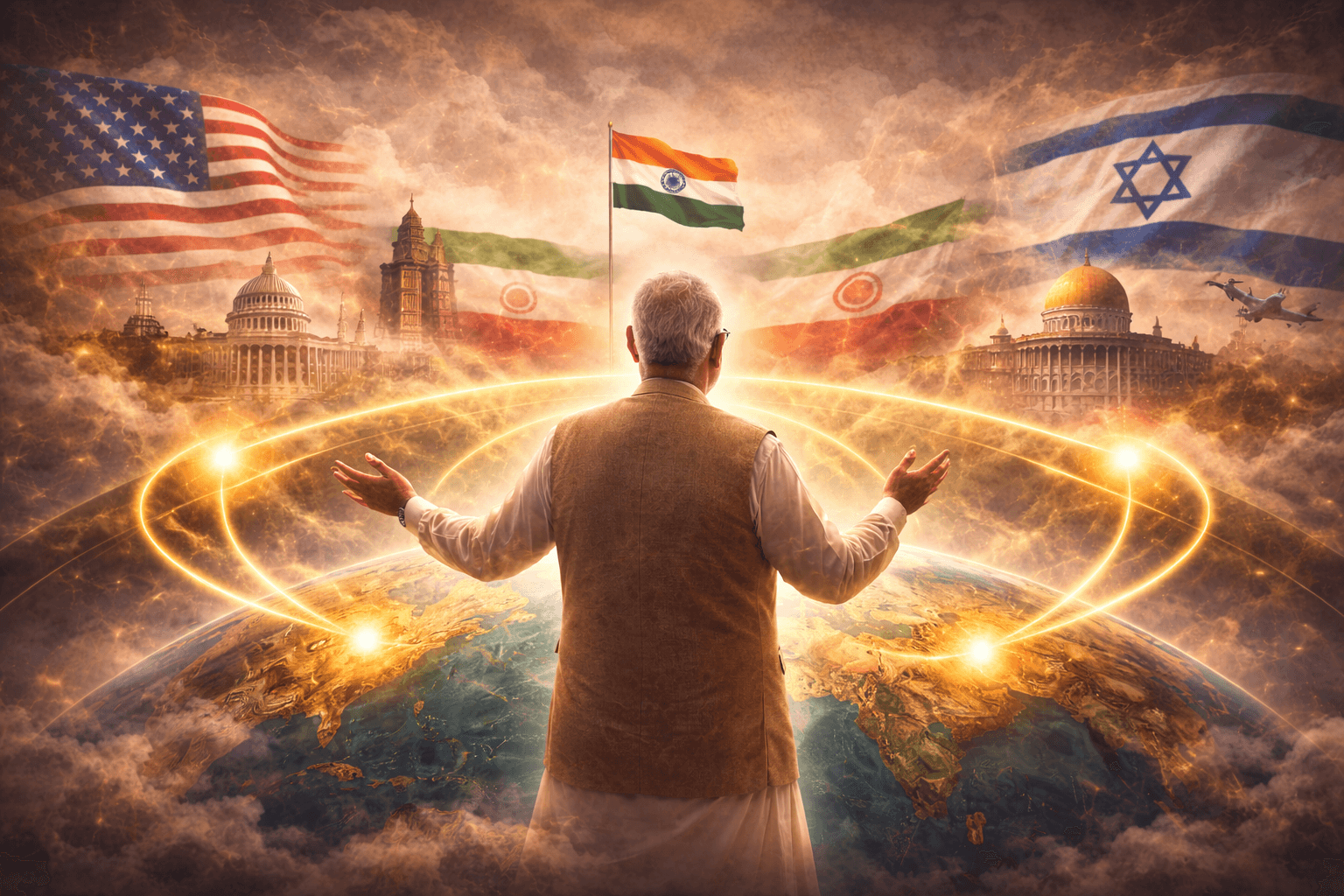
India navigates rising tensions between the US, Iran, and Israel through strategic autonomy—balancing relationships while safeguarding its economic and geopolitical interests.
As missiles streak across West Asian skies and oil routes choke under geopolitical tension, the ongoing US–Israel–Iran conflict is doing more than redrawing battle lines—it is quietly reshaping the global balance of power. But amid the noise of war, one country is choosing a different script. India.
Not as a bystander. Not as a participant. But as something far more consequential—a calibrated power navigating chaos with intent.
A War That Signals a Larger Shift
The current conflict is not just another Middle Eastern flashpoint. It is a stress test of the global order. For decades, the United States operated as the primary security anchor in the region. That assumption is now visibly under strain. Iranian retaliatory capabilities, disruptions in the Strait of Hormuz, and the widening conflict footprint—from Israel to the Gulf—have exposed the limits of unilateral dominance.
This is not the collapse of American power. But it is certainly the dilution of unquestioned authority.
The world, as many analysts now argue, is no longer unipolar. It is evolving—unevenly, unpredictably—into a multipolar landscape where influence is dispersed, negotiated, and constantly recalibrated.
And in such a world, rigid alliances are liabilities.
Flexible diplomacy is power.
India’s Doctrine: Engage All, Align with None
India’s response to the crisis has been notably restrained—almost understated. No dramatic declarations. No ideological positioning. Just a consistent call for restraint, dialogue, and de-escalation.
But beneath that restraint lies a deeply strategic approach.
India today maintains strong relations with:
- The United States (strategic, technological, defence ties)
- Israel (defence, innovation, intelligence cooperation)
- Iran (energy, connectivity, Chabahar port)
- The Gulf states (investment, diaspora, economic partnerships)
In most geopolitical frameworks, this would be seen as a contradiction.
In India’s framework, it is leverage.
This is not neutrality born out of hesitation. It is neutrality by design.
A conscious refusal to be boxed into binaries.
Economic Stability in a Storm
The most immediate impact of the conflict has been economic—particularly through energy markets. With the Strait of Hormuz under pressure and oil prices spiking, energy-importing economies face significant risk.
India, which imports nearly 90% of its crude oil, should have been among the most vulnerable.
Yet, the impact has been contained.
Years of strategic planning—diversified sourcing, strategic petroleum reserves, and expanding energy partnerships—have created a buffer. Supplies from Russia, the US, and the Gulf have allowed India to absorb shocks that would have otherwise destabilised its economy. Even more telling is India’s ability to maintain limited engagement with Iran—through calibrated mechanisms like humanitarian energy windows—without triggering geopolitical backlash.
This is not just economic management.
It is strategic insulation.
The Human Dimension: 10 Million Stakes
Beyond oil and geopolitics lies a quieter, more human reality.
Nearly 10 million Indians live in West Asia.
They are workers, professionals, entrepreneurs—the invisible threads connecting India to the region. Their remittances sustain families, communities, and economic flows back home.
In times of crisis, diplomacy is not just about strategy; it is about safeguarding lives.
India’s swift preparedness for evacuation, coordination with regional governments, and constant diplomatic engagement reflect a foreign policy that is not abstract—but deeply human.
This dual lens—strategic and humanitarian—is what sets India apart.
From Participant to Potential Peacemaker
Perhaps the most telling signal of India’s rising stature is not what it has done—but what others expect it to do.
Calls for India to play a mediating role in the conflict are no longer fringe opinions. From global leaders to strategic commentators, there is growing recognition that India is uniquely positioned to act as a bridge between hostile camps.
Why?
Because India speaks to all sides—and is trusted by all.
Unlike China, whose proximity to Iran raises questions of neutrality, or Western powers, who are directly involved, India carries neither historical baggage nor strategic overreach in the region.
Its legacy of non-alignment—once seen as idealistic—is now emerging as a geopolitical asset.
In a divided world, credibility is currency.
And India has accumulated it patiently.
A Masterclass in Strategic Autonomy
What we are witnessing is the maturation of India’s foreign policy.
For decades, India navigated global politics cautiously, often reacting rather than shaping outcomes. Today, that posture has shifted. India is no longer choosing sides.
It is choosing interests.
And more importantly, it is doing so without alienating partners.
This is not easy. It requires diplomatic agility, economic strength, and political clarity. One misstep could tilt perceptions. One overcommitment could limit options.
Yet, India has managed to maintain this balance—even as the world around it polarises.
That, in itself, is a quiet assertion of power.
The Bigger Picture: Winning Without War
In traditional geopolitics, power was often measured by military involvement or alliance strength.
But in today’s fragmented world, a different metric is emerging: The ability to stay relevant without being entangled.
India is demonstrating precisely that.
- It is economically resilient, despite global shocks
- It is diplomatically connected, across rival blocs
- It is strategically autonomous, without isolation
- And increasingly, it is seen as a stabilising force
This is not passive diplomacy.
It is active positioning.
Conclusion: The Advantage of Balance
The US–Israel–Iran conflict will eventually find an endpoint—through negotiation, exhaustion, or escalation. But its larger legacy will be the acceleration of a multipolar world.
In that world, countries that can balance relationships, absorb shocks, and maintain credibility will define the new order. India is not just adapting to this shift.
It is anticipating it.
By refusing to be drawn into binaries, by investing in resilience, and by keeping its diplomatic doors open to all, India is quietly crafting a role that goes beyond regional power—it is positioning itself as a global stabiliser.
In a world obsessed with taking sides, India’s greatest strength may well be this: It doesn’t have to.